| Description | Cystic Fibrosis Transmembrane Conductance Regulator (CFTR) |
|---|
| Description |
Cystic Fibrosis Transmembrane Conductance Regulator (CFTR)
|
| Catalog Number | U423Hu01 |
|---|
| Organism Species | Homo sapiens (Human) |
|---|
| Source | Prokaryotic expression |
|---|
| Expression System | E. coli |
|---|
| Endotoxin Level |
<1.0 EU per 1 µg
(determined by the LAL method)
|
| Subcellular Localization | Membrane |
|---|
| Predicted Molecular Mass | 68.1kDa |
|---|
| Accurate Molecular Mass | 68kDa |
|---|
| Residues & Tags | Met1~Gly330 with N-terminal His and GST Tag |
|---|
| Buffer Formulation |
20 mM Tris, 150 mM NaCl, pH 8.0,
5% Trehalose and Proclin 300.
|
| Form Supplied |
Lyophilized powder |
| Purity |
Purity was assessed by SDS-PAGE (≥98%)
and by HPLC.
|
| SDS-PAGE |
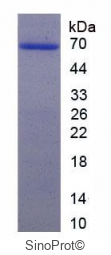 |
| Isoelectric Point | 9.7 |
|---|
| Applications |
Positive Control; Immunogen; SDS-PAGE; WB.
|
| Storage Instruction |
We recommend a quick spin followed by
reconstitution in water to a concentration
of 0.1–1.0 mg/mL.
This solution can then be diluted into
other aqueous buffers and stored at 4°C
for 1 week or at -20°C for future use.
|
| Stability |
The thermal stability is described by
the loss rate. The loss rate was determined
by accelerated thermal degradation testing
at 37°C for 48 hours.
No obvious degradation or precipitation
was observed under the stated test conditions.
The loss rate is less than 5% within the
expiration date under appropriate storage
conditions.
|
| Notes |
For in vitro laboratory use only.
Not for clinical, therapeutic, or diagnostic
use in humans or animals.
Not for animal or human consumption.
|